
Any question about the article?
Please use your work e-mail, so we can connect with you
There is something about fishing I’ve learned over the years: sometimes the difference between a productive day on the water and a frustrating one comes down to timing.
You have to understand the water, pay attention to changing conditions, and recognize when fish are likely to be active. One subject that has always interested me is solunar tables for fishing, particularly the influence of the full moon and the major and minor feeding periods.
Bass anglers, inshore fishermen, and offshore anglers have all paid attention to moon phases and feeding patterns. But can the moon influence when fish feed? How do major and minor periods help us identify productive fishing windows? And how can we use solunar information to plan better trips?
Let’s look at how solunar tables work, what research tells us, and how I use this information when planning time on the water.
Solunar tables are fishing calendars designed to identify possible periods of increased fish activity based on the positions of the sun and moon.
The concept became popular through John Alden Knight, who developed his Solunar Theory in the 1920s and published the first Solunar Tables in 1936. The Florida Fish and Wildlife Conservation Commission provides an overview of Knight’s work and explains how sunrise, sunset, moon phase, moonrise, moonset, and geographic location are used in solunar calculations.
Solunar calendars generally identify two types of daily activity periods:
| Period | What it means |
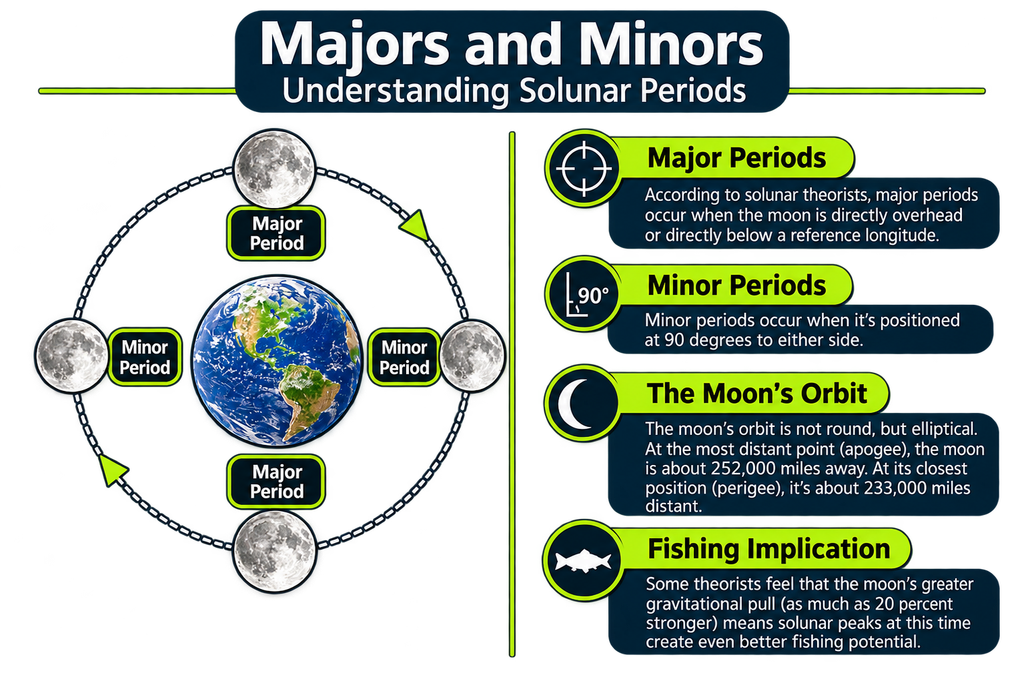
| Major periods | When the moon is directly overhead or directly beneath your location |
| Minor periods | Times surrounding moonrise and moonset |
Major periods are generally considered the strongest predicted feeding windows, while minor periods offer additional opportunities for activity.
These times vary by geographic location because the moon’s position, moonrise, and moonset change depending on where you are. Many calendars also include moon phases, sunrise, sunset, and daily activity ratings.
For anglers, this information provides another way to decide when to be on the water and when to concentrate on productive areas.
If you’ve never used a solunar calendar, the information can look confusing at first. Once you understand the basics, it’s easy to follow.
A typical table gives you several pieces of information for a particular location and date:
| What you see | What it tells you |
| Major periods | Predicted primary activity windows |
| Minor periods | Additional activity windows |
| Moonrise | When the moon rises |
| Moonset | When the moon sets |
| Sunrise | Beginning of daylight |
| Sunset | End of daylight |
| Moon phase | Where the moon is in its lunar cycle |
| Location | Determines the exact timing |
The most important thing is to make sure the calendar is calculated for your actual fishing location. A solunar table for another city can give you different times.
Major periods occur when the moon is directly overhead or beneath your location. They are generally considered the strongest predicted feeding windows.
Minor periods occur around moonrise and moonset and are usually shorter.
In-Fisherman describes the same distinction and explains how these periods relate to the movements of the Earth and moon.
For example, a calendar might show:
| Period | Example time |
| Major period | 7:00 a.m. – 9:00 a.m. |
| Minor period | 12:30 p.m. – 1:30 p.m. |
| Major period | 7:00 p.m. – 9:00 p.m. |
| Minor period | 1:00 a.m. – 2:00 a.m. |
These are illustrative times, not an actual forecast.
If I’m planning a trip, I try to be on the water before a predicted major period begins. That gives me time to locate fish, identify productive structure, and get my presentation right before the activity window arrives.
I also pay attention to minor periods. They can help me plan a shorter trip or adjust my schedule around the day’s predicted activity. Sometimes the timing lines up, and it pays off with a nice catch.
Sunrise and sunset are important periods for many anglers because changing light conditions can influence how fish feed and position themselves.
Think about largemouth bass moving toward shallow vegetation early in the morning or saltwater predators feeding along mangrove shorelines as light levels change.
Moonrise and moonset add another layer of information. When a major or minor solunar period overlaps with sunrise or sunset, it creates an interesting window to plan around.
I pay attention to these overlaps because they help me decide when to be in the right area and ready to fish.
My experience with solunar calendars also influences how I prepare for tournaments. Check out my latest video, Tournament Fishing Made Easy, to see how that preparation translated into time on the water.
The four primary moon phases are:
New and full moons generally produce stronger spring tides, while quarter moons generally produce weaker neap tides. This is particularly important for saltwater fishing, where water movement can influence feeding opportunities.
For freshwater anglers, moon phases can also provide useful seasonal information, especially when certain species are preparing to spawn.
The moon phase and daily major and minor periods work together to help anglers understand the lunar cycle and identify possible activity windows.
The answer depends on where you’re fishing.
Solunar tables for fishing near me can produce different results than a calendar calculated for another city or state. Even locations relatively close together can have different moonrise, moonset, sunrise, and sunset times.
When checking solunar tables for fishing today, I recommend looking at:
| Check | Why it matters |
| Fishing location | Determines astronomical timing |
| Major periods | Primary predicted activity windows |
| Minor periods | Additional shorter windows |
| Sunrise and sunset | Changing light conditions |
| Moon phase | Lunar-cycle context |
| Weather forecast | Helps put the prediction in context |
| Tides | Especially important for saltwater |
If I’m fishing a Florida lake, I might plan around an early morning major period and work shallow vegetation before the sun gets high.
If I’m fishing an inshore saltwater flat, I’ll look for a promising activity window that also lines up with favorable tidal movement. For freshwater fishing, I’d try a different approach.
The important thing is to use the calendar as a planning tool. Knowing when major and minor periods occur gives you a starting point, but you still have to read the water and adjust to the conditions.
This is where things get more interesting.
There is evidence supporting a relationship between solunar periods and fishing activity in some situations, but the research does not show that solunar tables can reliably predict when fish will bite across all species and conditions.
One of the most detailed examples comes from fishery scientist Ralph Manns. His long-term bass dataset included 2,500 fishing trips, 10,466 hours of fishing, and 8,900 bass measuring at least 12 inches. His analysis found higher bass catch rates around major and minor solunar periods.
But other research has reached different conclusions.
A 2023 peer-reviewed study tested 7 popular solunar services against 361 trout fishing trips covering more than 1,355 hours. The researchers found no significant relationship between the solunar predictions and catch rates. Ambient air temperature was a better predictor of fishing success than any of the solunar tables tested.
So the answer to do solunar tables work for fishing is more nuanced than a simple yes or no.
They can be useful for identifying times worth paying attention to, but they should not be treated as a guarantee that fish will feed.
Read also: https://fishbox.com/blog/fly-fishing
The accuracy depends on what you mean by “accurate.”
Astronomically, moonrise, moonset, and lunar transit can be calculated precisely for a given location. The uncertainty comes from assuming that these astronomical events reliably predict fish activity.
Research suggests that the relationship varies by species, location, season, and environmental conditions. Manns’ bass research found a relationship in his dataset, while the trout study found no significant relationship between solunar predictions and catch rates.
So I think of solunar predictions as timing signals, not promises.
Bass are one of the species most frequently discussed in connection with solunar fishing.
Ralph Manns’ long-term bass dataset provides some of the strongest angler-focused evidence for a relationship. His analysis found higher catch rates around major and minor periods, particularly during parts of the year when bass were more responsive to solunar timing.
In-Fisherman reports that the relationship was strongest from May through November and that light and weather could often overwhelm lunar effects.
That distinction matters.
A major period doesn’t tell you:
It simply gives you another reason to pay attention to that particular window.
Of all the lunar phases, the full moon is one I particularly enjoy fishing around.
A full moon provides more natural light at night, which can influence the behavior of prey species and predators. Lunar cycles also play a role in spawning activity for certain fish species.
The full moon is also associated with stronger tidal ranges in coastal waters. When the sun, moon, and Earth align around a new or full moon, stronger spring tides generally occur. For saltwater anglers, moving water can concentrate baitfish and other food sources around oyster bars, mangroves, channels, passes, and grass flats.
There’s another reason I pay attention to the full moon: panfish.
When targeting panfish, I’ve noticed that the three days before and three days after a full moon can be productive, especially when bluegill and shellcracker (redear sunfish) are moving into their spawning patterns. It’s a pattern I’ve personally watched over the years.
The Florida Fish and Wildlife Conservation Commission also identifies full-moon periods in March and April as important times for shellcracker spawning.
That doesn’t mean every full moon guarantees a great day of fishing. It does give me another reason to check the calendar and plan a trip.
This is one of the most important parts of using a solunar calendar correctly.
Solunar periods provide useful timing information, but I always consider them alongside the actual conditions on the water.
| Condition | What it can change |
| Weather fronts | Fish activity and positioning |
| Barometric pressure | Feeding behavior |
| Water temperature | Metabolism and seasonal movement |
| Wind | Current, bait movement, water clarity |
| Water clarity | Predator behavior and lure visibility |
| Tides | Feeding opportunities in saltwater |
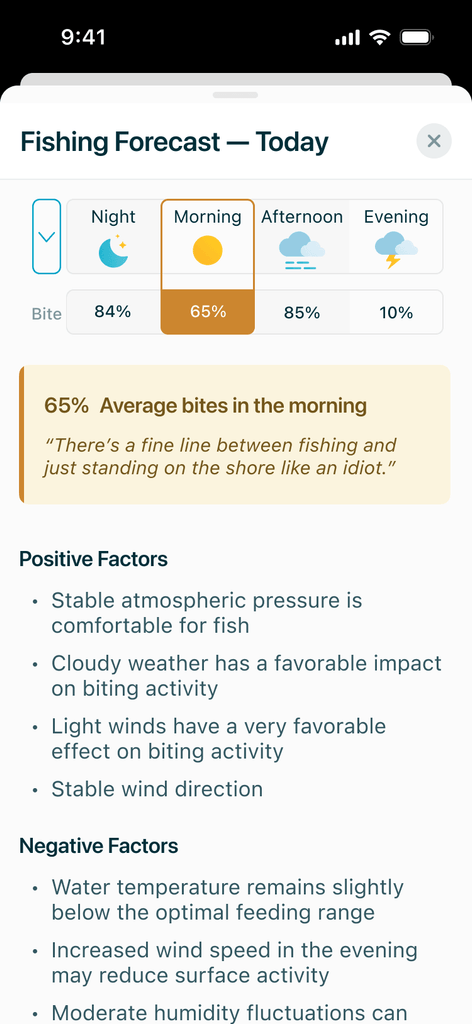
When a strong solunar period lines up with favorable weather, good water conditions, and moving tides, that’s a fishing window I want to take advantage of. Having the Fishbox makes it easy for me to quickly check these conditions before heading out to the water.
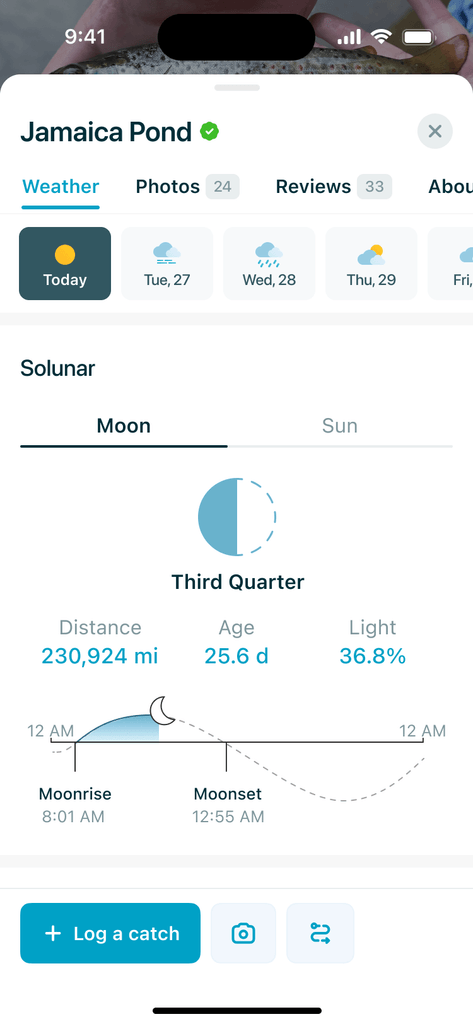
But if the weather changes or the fish aren’t cooperating, I adjust. A calendar shouldn’t keep you from making decisions based on what you’re actually seeing.
Over the years, I’ve learned that planning a fishing trip involves more than just picking a lake and putting the boat in the water. I pay attention to the weather, water conditions, seasonal patterns, and what the fish are likely doing.
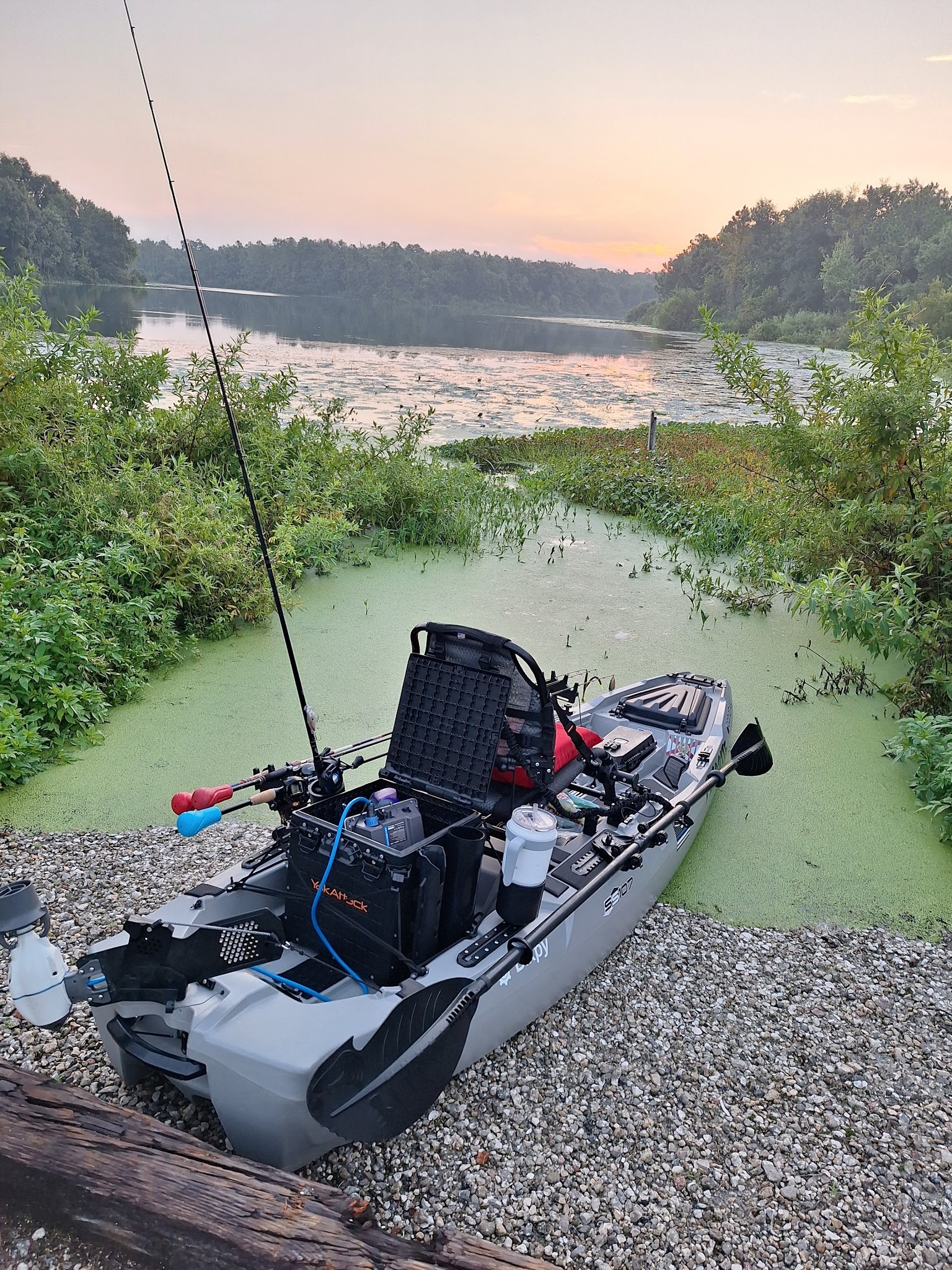
On one recent fishing trip, I used the solunar calendar as part of my planning. I noticed a major period was scheduled during the morning, so I made a point of being on the water ahead of it.
Once I got started, I focused on the areas where I normally expect to find Florida bass: grass lines, hydrilla edges, and places where baitfish might be moving. I tied on a soft-plastic worm and worked the vegetation, changing my presentation as I moved through different areas.
As the major period approached, I concentrated on the areas that looked the most promising. I wasn’t expecting the calendar to do the fishing for me. I still had to locate the fish, choose the right presentation, and make adjustments.
Was the moon responsible for fish activity? I can’t say that for certain. But it gave me another piece of information to consider, and that’s how I believe solunar tables should be used.
Another thing I’ve learned from fishing is that not every trip starts with a detailed plan. Sometimes I simply have an opportunity to get out on the water, and that’s reason enough for me to go.
On another fishing trip, I focused on the conditions in front of me rather than checking the solunar calendar first.
I started by looking for familiar bass-holding areas, including vegetation, grass edges, and places that offered fish a good ambush point. I worked through different areas and adjusted my presentation based on what I was seeing.
Later, I checked the solunar information and compared the day’s fishing window with the predicted major and minor periods. It made me think about whether knowing those times ahead of the trip might have changed how I planned my morning.
That’s one reason I believe it’s worth checking a solunar calendar before heading out. You may not change where you fish or what lure you throw, but knowing when the predicted activity periods occur can help you organize your time on the water.
I wouldn’t plan every fishing trip around a solunar calendar, but I wouldn’t ignore one either.
I believe the best approach is to combine solunar information with experience, weather forecasts, water temperature, seasonal patterns, and what you observe while fishing:
| Solunar conditions | Weather/water conditions | How I’d treat it |
| Strong major period | Favorable | High-priority fishing window |
| Major period | Difficult weather | Worth watching |
| Minor period | Favorable | Good secondary window |
| No strong solunar period | Excellent conditions | Still worth fishing |
| Strong solunar period | Poor conditions | Don’t rely on it |
Pay attention to when you get bites, what the weather is doing, and whether those bites happen near major or minor periods. Over time, you may start recognizing patterns that help you make better decisions on your favorite lakes.
For me, solunar tables are another tool in the tackle box.They don’t guarantee a catch, but they can help me make a better plan before I ever leave the house.
When looking for free solunar tables for fishing, choose a calendar that shows major and minor feeding periods alongside moonrise, moonset, sunrise, sunset, and moon phase. In-Fisherman’s Best Fishing Times is one resource worth checking.
You can also use Fishbox to view fishing forecasts and bite-related insights alongside other useful tools. While its solunar forecasting features are still developing, I find it helpful to compare the available bite predictions with local conditions, plan trips, and keep track of my fishing activity in one place.
Whether you’re fishing for largemouth bass in a Florida lake, chasing redfish along a mangrove shoreline, targeting snook around an inlet, or heading offshore, solunar timing gives you another piece of information to consider when planning your next trip.
After spending years fishing different waters, I’ve learned that timing matters.
The full moon is one of the lunar periods I pay particular attention to, and I enjoy watching how different species respond to changing conditions.
For saltwater fishing, I consider lunar phases because of their relationship with tides and water movement. For freshwater fishing, I pay attention to moon phases and solunar periods when planning around seasonal feeding and spawning activity.
But I don’t treat solunar tables as a crystal ball.
The evidence is mixed. Some bass-fishing research has found meaningful relationships between catch rates and solunar periods, while other research has found no predictive relationship at all.
That’s why my answer to how accurate are solunar tables for fishing is simple: they’re useful for planning, but they aren’t precise bite predictors.
My advice is simple: check the solunar calendar before your next trip. Look at the major and minor periods, pay attention to the moon phase, check the weather and water conditions, and plan to be on the water when several favorable factors come together.
Keep track of your catches and the conditions surrounding them. Over time, you can learn which lunar periods line up with productive fishing on your favorite lakes, rivers, flats, and offshore locations.
The next time a full moon approaches, check your calendar, look at your solunar periods, and plan a trip. You might discover that a great fishing window is right around the corner.
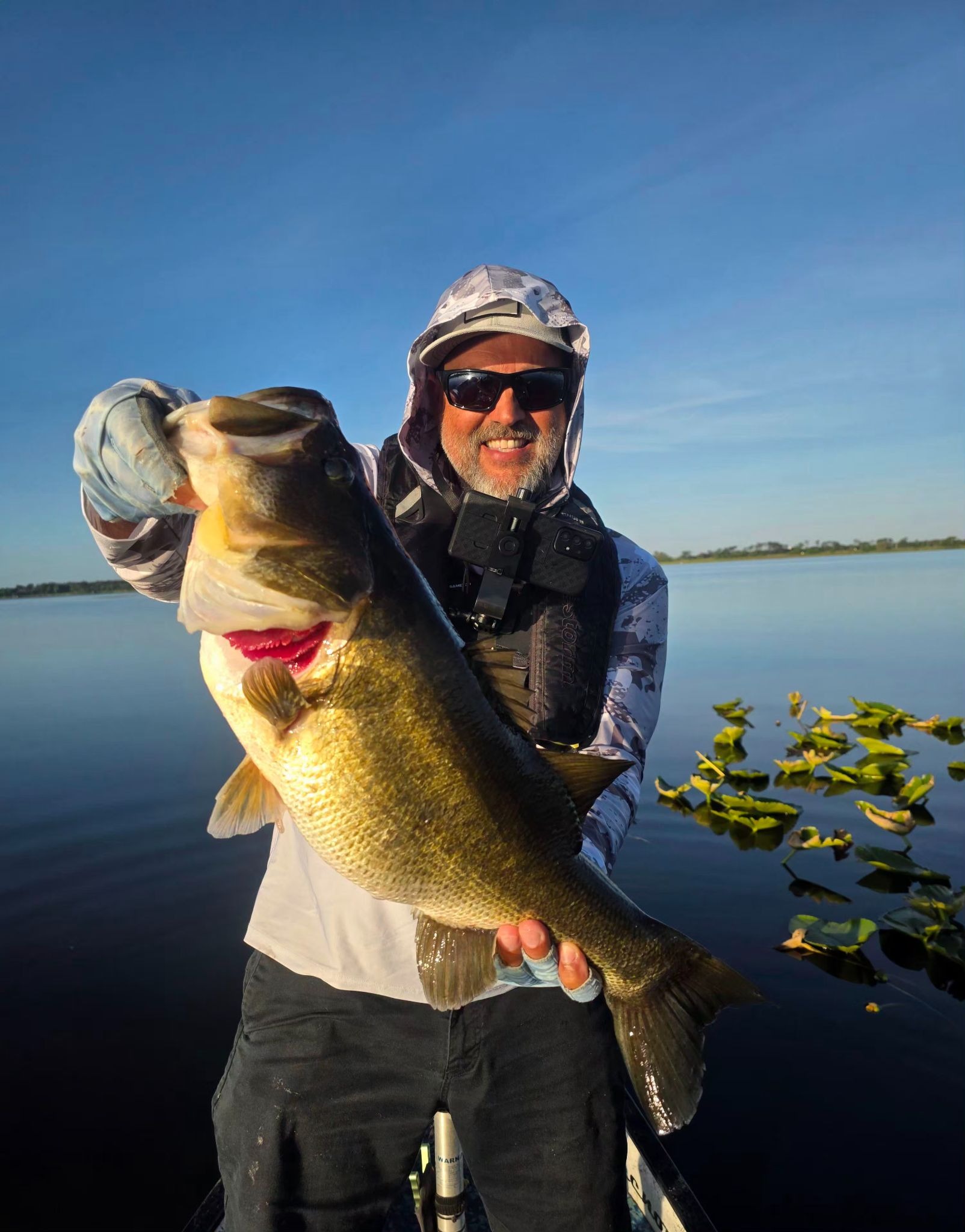
Dale Templeton is a Central Florida bass angler and local tournament competitor who specializes in largemouth bass. He shares simple, proven techniques that help anglers of every level catch more fish.