
Any question about the article?
Please use your work e-mail, so we can connect with you
Let’s start with how we all got here.
You probably walked into a tackle shop, or opened a tab at 1 a.m., and discovered there are two completely different kinds of rod. Then you found Reddit, and now you’re wondering whether you need a PhD in thumb-control to catch a largemouth.
Both setups catch the same fish, work with many of the same lures, and cover a ton of freshwater situations. They’re just not interchangeable, and picking the right one makes your day on the water a lot easier (and a lot less tangled).
The short version: a spinning setup is easier to learn and great with lightweight lures. A baitcasting setup gives you more control and shines with heavier lures and specific targets like docks, laydowns and vegetation.
I’ve fished enough different waters to know the best setup isn’t the most expensive or the most advanced one. It’s the one that matches what you’re fishing for, what you’re throwing, and how you like to fish.
So let’s break down the casting rod vs. spinning rod question, see what real anglers argue about online, and figure out what you should buy.
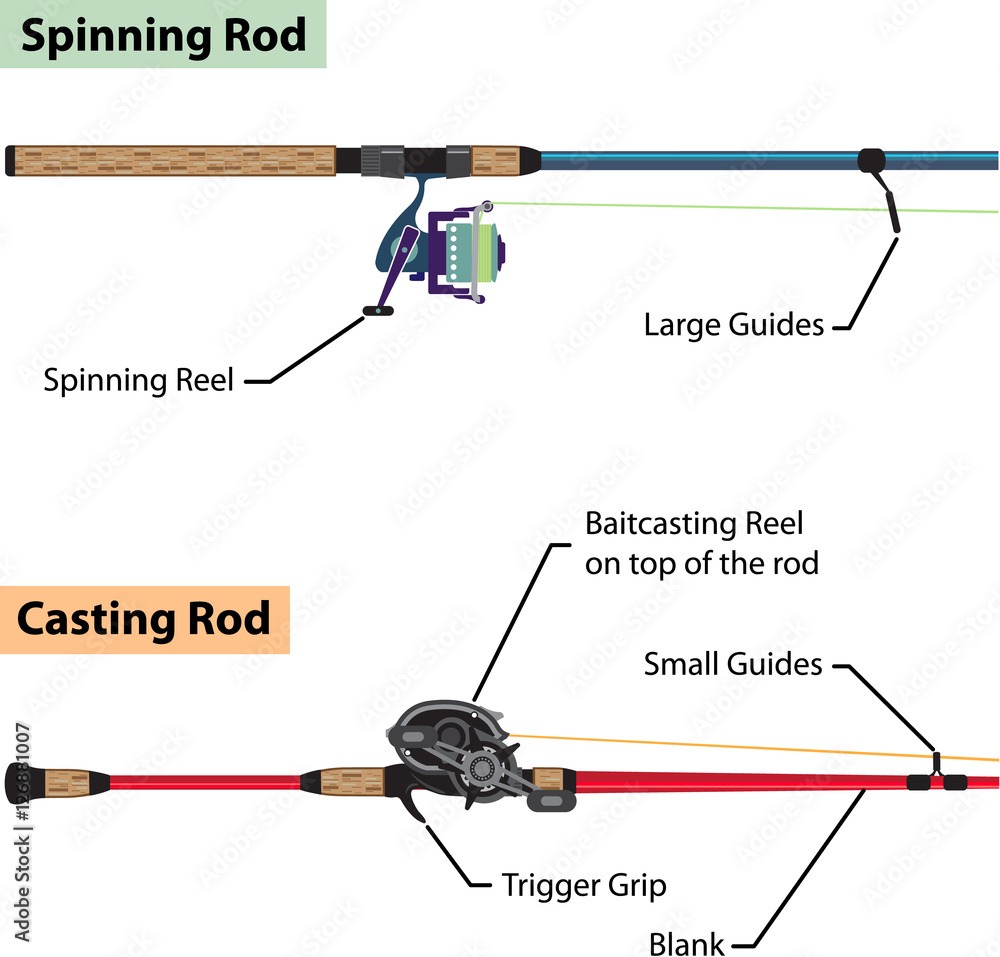
At first glance the two look pretty similar. Both come in different lengths, powers and actions, and both work for freshwater fishing. The real difference is where the reel sits and how line leaves the spool.
I also liked this diagram from AB Posters because it provides a closer look at the different rod components we’ll be discussing, making it easier to understand their structure and key differences.
To make things easier to follow, here’s a quick cheat sheet:
| Feature | Spinning rod | Casting rod |
| Reel position | Underneath the rod | On top of the rod |
| Casting technique | Easier to learn | Requires more practice |
| Best lure weight | Light to medium | Medium to heavier |
| Casting control | Good | Excellent with practice |
| Line tangles | Less prone to backlash | Can experience backlash |
| Best for | Beginners, finesse fishing, lighter lures | Bass fishing, heavier lures, precision casting |
| Learning curve | Relatively easy | Steeper |
Neither is automatically better. They’re just different tools, like a screwdriver and a drill.
I also came across a great video overview that breaks down the differences between spinning and casting setups. It’s worth a watch if you’d rather see the two in action before deciding which one is right for you.
A spinning rod is my default recommendation for anyone just starting out. It’s forgiving, versatile, and doesn’t demand a weekend of backyard practice before you can fish.
Its superpower is lightweight lures. Small soft plastics, light jigs and compact crankbaits are easy to cast without fighting the reel. Game & Fish Magazine makes the same point: lures as light as 1/8 ounce can be delivered to distant targets on medium-light spinning gear with 2000- to 3000-size reels, and spinning has gotten even more useful thanks to modern small-diameter braids.
I’d grab a spinning rod when:
Spinning reels are also easy on beginners because you’re not babysitting a rotating spool on every cast.
That said, “easy” isn’t “foolproof.” Line twist, a badly filled spool, or the wrong line size can still ruin your morning. Spool it properly and match your line to the reel.
A couple of spinning rods worth checking out:
A casting rod earns its spot when you want tighter control over your presentation, especially for bass.
Once your technique is consistent, you can drop a lure right beside a submerged log, dock piling or weed edge. Casting setups also pair beautifully with heavier lures: bigger spinnerbaits, jigs and heavier Texas rigs. Better leverage, better control, and better hook-setting power when a fish tries to bury itself in cover.
I’d grab a casting rod when:
The big downside is the learning curve. Mess up spool control and you’ll be picking out line instead of fishing. That’s why so many beginners get frustrated and give up on baitcasters.
My baitcaster starter kit:
If you’re buying your very first rod, I’d start with spinning.
You can learn casting, retrieves and lure presentation without worrying about spool control. That means more time fishing and less time untangling the line. Spinning gear also tends to cost less, which is a nice bonus when you’re still figuring out whether you’ll fish every weekend or twice a year.
A solid first setup: a medium-power spinning rod around 6’6″–7′, paired with a 2500-size spinning reel and line suited to your target species. Once you’re comfortable, add a baitcaster to the collection.
That said, don’t assume a casting rod is “too advanced.” If your whole goal is flipping and pitching heavier lures for bass, learning on a baitcaster from day one can make sense. Just be patient with yourself.
The golden rule: match the gear to the fishing you actually want to do.
Before you buy anything, it’s worth understanding rod length, power and action, because those matter just as much as spinning vs. casting. If you need the basics, check out our guide on how to set up a fishing rod for beginners.
A couple of casting rods worth checking out:
Remember to choose a casting rod that matches your reel, lure weights and target species. A casting rod alone isn’t a complete setup.
Spend ten minutes on a fishing forum and you’ll learn that spinning vs. baitcasting is basically fishing’s version of tabs vs. spaces. People care.
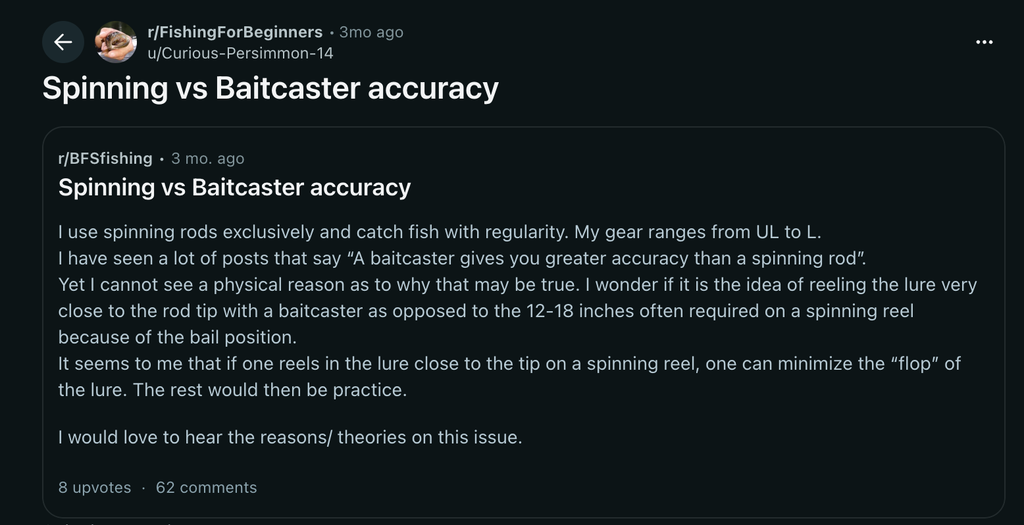
Probably the most common pro-baitcaster argument.
In a Reddit discussion about spinning vs. baitcaster accuracy, anglers debated whether baitcasters have a built-in accuracy edge. The big pro-baitcaster point was thumb control: you can slow the spool mid-flight and stop the lure almost instantly when it reaches your target. Others replied that an experienced spinning angler can also feather the line and hit tight spots.
My take: Baitcasters do give you great control over the lure during the cast. Feathering the spool to stop a lure right beside a dock or under an overhanging branch is genuinely useful. But buying a baitcaster won’t magically make you accurate. Practice beats gear. BassResource forum members have been saying the same thing for years: a baitcaster won’t make you a better angler, and a spinning reel won’t hold you back.
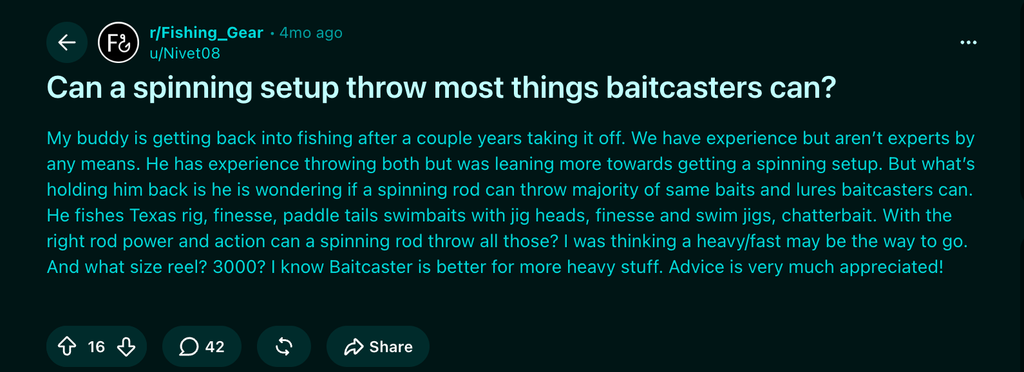
A Reddit thread about whether spinning setups can handle most fishing techniques tackled exactly this. One popular view: spinning gear handles almost any lure, while baitcasters struggle more with light presentations. The counterpoint: baitcasters are better with heavier lures, stronger line and demanding conditions.
Both sides have a point. You can catch bass on a spinning rod using techniques people usually associate with baitcasters. But “can” and “comfortable” aren’t the same thing.
My take: If I could only own one setup for general freshwater fishing, it’d be a spinning rod. It’s flexible, great with light lures, and doesn’t box you into one style. But if I were mostly chasing largemouth in heavy vegetation, a baitcaster would absolutely be in my truck.
Bass fishing is where this choice gets interesting. You can catch largemouth on either one, so the decision usually comes down to the lure and the structure.
Working a lightweight soft plastic around open water? Spinning is the natural pick: lighter presentations are easier to cast and you can keep a controlled retrieve. Pitching big jigs into heavy vegetation, or digging bass out of submerged cover? I’d lean casting.
Here’s how I’d match common techniques:
| Bass fishing technique | Recommended setup | Why |
| Drop shot | Spinning | Handles lightweight presentations well |
| Ned rig | Spinning | Great for finesse fishing |
| Wacky rig | Spinning | Easy casting with lighter plastics |
| Texas rig | Both | Depends on weight and cover |
| Spinnerbait | Casting | Good control with heavier lures |
| Chatterbait | Casting | Handles heavier moving baits |
| Frog fishing | Casting | Well suited to heavy line and thick cover |
| Heavy jigs | Casting | Useful around vegetation and structure |
These aren’t commandments. Plenty of experienced anglers use spinning rods for “baitcaster” techniques and vice versa. Even pro-level tournament anglers have won money on spinning tackle, as Outdoor Life points out.
Where you fish should shape your choice too.
From the shore, you may have lots of room for long casts. A spinning rod is versatile for covering open water, while a casting setup can help when you’re picking apart specific structure.
From a kayak, things get cozy. One of the anglers talked about using the BonaFide SS107 to reach Florida backwaters and spots bigger boats can’t. When space is tight, you want gear you can handle without constantly shifting your weight. A manageable rod length and a setup that suits your favorite lures can make a big difference.
I wouldn’t pick spinning or casting just because I’m in a kayak. I’d pick based on the fish, vegetation, water depth and presentation I plan to use. Same goes for bank fishing: your surroundings and casting room matter as much as the rod.
Before you buy, ask yourself:
1. What species am I targeting? Bass, trout and crappie don’t always need the same equipment. A setup built for largemouth in heavy cover can be overkill for smaller species.
2. What lures do I throw most? This is the big one. Mostly lightweight soft plastics? Spinning. Heavier jigs, spinnerbaits and frogs? Casting may fit better.
! One exception worth mentioning: fly fishing requires an entirely different setup, so neither a spinning nor a casting rod will do. You’ll need a dedicated fly fishing rod designed to cast lightweight flies using the weight of the fly line.
3. Where am I fishing? Open water, shallow vegetation, submerged structure and rocky shorelines all call for different approaches.
4. What are the conditions? Wind, water clarity and seasonal fish behavior all affect lure choice and presentation.
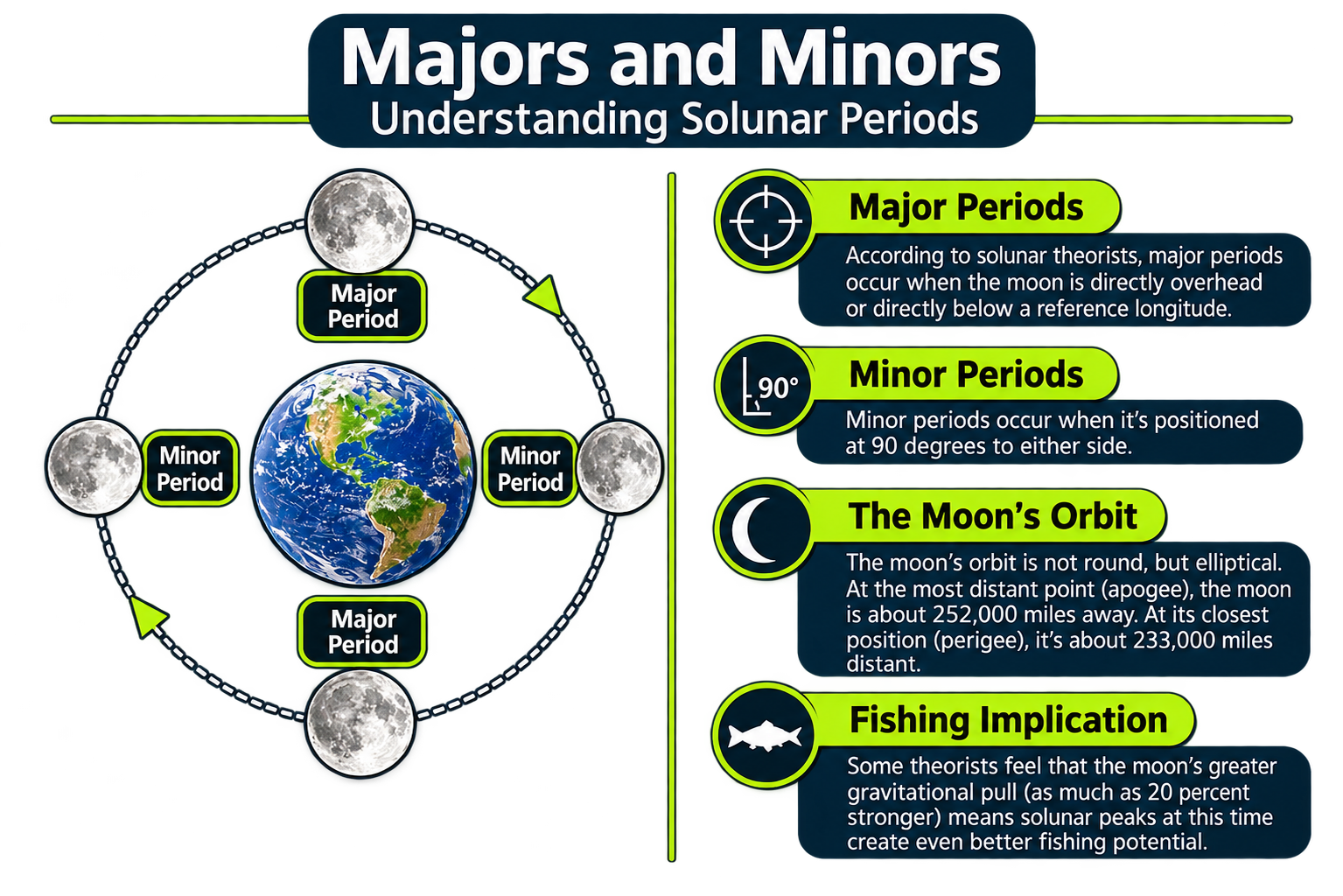
This is also where trip planning pays off. Before heading out, I like to know what conditions I’m walking into instead of hauling the same rods everywhere. I explore fishing spots on the map, check local fishing forecasts, and look at conditions that help me decide where and when to fish. It’s a handy way to narrow down your options before picking a setup for the day, same goes for knowing about solunar table.
If you’re planning a trip but aren’t sure when you can fish without buying a license, check our guide to USA free fishing days.
If you want one recommendation: a medium-power spinning rod. It’s versatile, easy to learn, and good for a huge range of freshwater fishing.
But if you’re serious about bass and want to work heavier lures around vegetation, docks and submerged structure, a casting rod is absolutely worth learning.
Eventually, you’ll probably own both, which is when the debate gets a little pointless. These aren’t rival technologies where one has to win. They’re tools built for slightly different jobs.
My advice? Don’t spend a fortune on your first rod, and don’t buy a baitcaster just because someone on Reddit said so. Find something comfortable, match it to the lures you actually use, and spend more time fishing than worrying about perfect gear.
And before your next trip, check Fishbox for nearby fishing spots and local conditions. Sometimes choosing the right place and time matters more than choosing between two rods.