Any question about the article?
Please use your work e-mail, so we can connect with you
Hi, I’m Sam. I’m a fly fisherman based in Central Oregon and East Tennessee, and I love exploring small creeks and streams in the spring and summer, alpine lakes in the summer and fall, and big rivers during the winter.
In this guide, I’ll walk you through the basics I wish every new angler knew from choosing your first gear and setting up your rod to learning essential knots, practicing your cast, choosing the right fly, and eventually landing your first fish.
If you’re beginning with fly fishing, you don’t need to know everything before you get on the water. You just need the right setup, a little practice, and somewhere good to start.
Fly fishing is where you use a rod and reel to cast a fly – a hook that is dressed up to mimic a fly or a life stage of a fly – into a stream, river, lake or even the ocean to catch a fish. Most of the time, one is fly fishing for trout, however, salmon, char, tarpon and bonefish among other fish species are fair game as well.
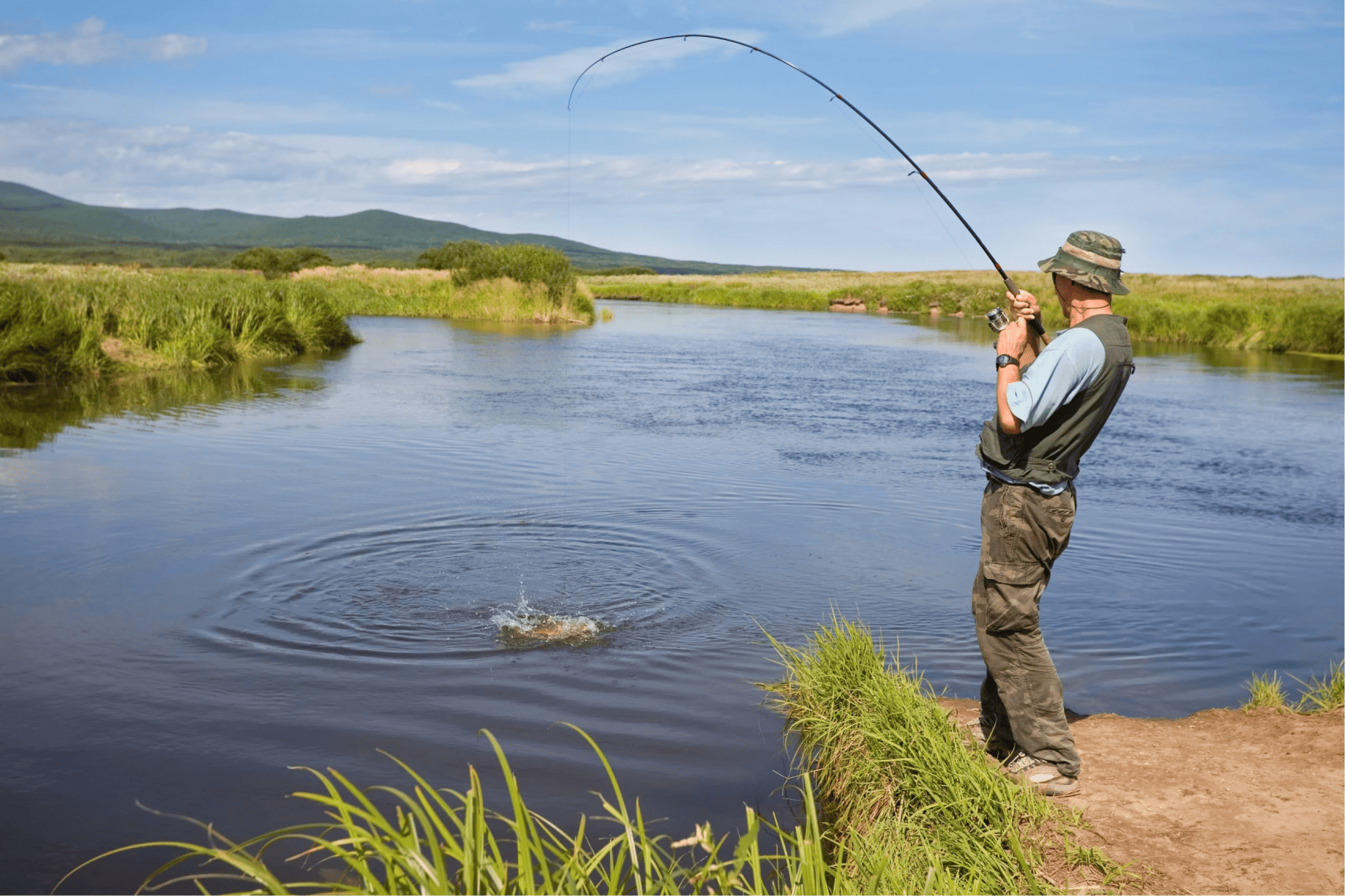
Here’s a look at what fly fishing for trout can look like on the water:
In fly fishing, the weight of the line and bend of the rod is used to cast distance as opposed to the weight of the lure in spin fishing, making it more challenging and fun. One is also trying to simulate the movement of a natural fly as it lands on the water and then floats downstream (whether on the surface or eventually underneath).
With so many factors – choosing the right fly, casting it, and moving it carefully through the water – the art and skill of the fly fisherman becomes paramount in catching a fish. The ultimate payoff is when you feel that tug on your line and set the hook, and the fight begins.Easy steps to get started with fly fishing
Go to your closest fly shop if available and talk to them about getting a fly rod. They will most likely get you started on a 5 weight 9 foot rod as it is an all-around rod that is fairly versatile.
If your area has a certain type of fly fishing that it is known for, however, they may recommend a different type of rod that is better suited. They will also suggest rivers, streams and/or lakes that a beginner should start on, or you can get that info yourself by looking at nearby spots.
I prefer going to a fly shop to buy my gear as it supports them and they also are a wealth of knowledge as to what works best for the bodies of water near them. In general, you want a river, stream or lake that is known for large numbers of fish and where the fish are easy to catch. A lot of fly fishing successfully is about building up your confidence. So you need to make it as easy as possible to start.
For a first trip on small streams and mountain lakes, Rocky Mountain National Park is hard to beat. Fly Fish RMNP’s guide to fly fishing Rocky Mountain National Park covers beginner-friendly water such as the Big Thompson River in Moraine Park and Sprague Lake.
For anyone putting together their fly fishing gear for beginners, a local fly shop can also help you avoid buying equipment you don’t really need.
To start, I would recommend going with a quality rod and specifically, the Orvis Clearwater 9 foot 5 weight, or equivalent. It is a versatile rod and moderately priced. You can buy much cheaper rods from online sources, however, this is one area where I would not skimp on as a beginner to fly fishing. The reel is another story.
I started with an inexpensive Piscifun Sword Fly Fishing Reel, CNC-Machined Aluminum Alloy Fly Reel 5/6 weight from Amazon. It will have the backing and fly line already pre-loaded.
All you have to do is add a fly leader (the line that connects your fly line to the hook or to a smaller line called a tippet that is connected to a hook), tippet and a fly (the dressed up hook made to look like an insect stage – ie fish food). Once you get better versed in fly fishing, and move on from being a beginner, you can move up to a better quality reel and line.
Your fly rod will come in four sections tapering from thicker at the base where your reel sits to thinner at the tip. Each section will have guides that the line passes through. The reel will fit in at the base where you will see a notch that the reel frame slides into, and then a ring fits over the other side and is secured with a threaded ring also on the base of the rod.
Once the reel is secured to the rod, you can pass the line through the guides and out the tip of the rod. Then connect the end of the fly line to a leader using what is called a loop to loop connection (both the fly line and the leader will have loops at their ends).
I recommend using a Rio Power Flex Trout leader (5x 9ft tapered). At this point, you can connect a fly directly to the leader or add what is called a tippet to the end of the leader – and then a fly to the end of the tippet. A tippet simply extends your leader by a few feet or more.
This gives you a basic fly fishing rod for a beginner.
With this fly fishing setup, you have a number of options:
Other gear that you need include a rubber lined net, some sort of gear bag (I love the Canyon Creek chest pack from Fishpond), a fly box, nippers, extra tippet spools (at least have a 4x, 5x and 6x spool – I use ones from either Rio, Orvis or Scientific Angler), waders and wading boots, and some hemostats to retrieve the hook if it is embedded deep in a fishes’ mouth.
Together, these pieces make up a practical fly fishing kit for beginners.
Read also: Freshwater Fishing: A Complete Guide to Catching More Fish from the Bank or Boat
The first knot that you will learn is the Improved Clinch knot. All of my flies are attached to my line with this knot.
Other knots to learn are the Perfection Loop knot (I use it to connect lines such as tippet together), a Surgeons knot (to extend your leader with tippet) and a Blood knot (to extend your leader with tippet).
Fishbox has some great videos on knot tying in the app. I highly recommend viewing them. And then practice, practice, practice.
If you are like me, you just want to get on the river or lake as fast as possible. So if you live near one, head straight to the water. I practiced right at the river – made a ton of mistakes, and ended up catching my first fish probably a little sooner than had I spent a lot of time practicing ahead of time.
If, however, you live far from the river, then practice at home (driveways are great or even a school field) so that when you do get to a body of water, you will be ready to fish.
There are plenty of fly fishing videos for beginners that can help you see the casting motion before you practice it yourself.
Want to see how I got started? Watch this video and follow along as I share my own fly fishing experience.
You can also learn a lot from fly fishing classes for beginners, especially if you prefer having an instructor correct your technique in person. In Northern Ireland, Islandderry Trout Fishery near Dromore offers fly tuition and a dedicated beginners’ pond, an easy place to practice on stocked trout.
In casting, you will hear anglers talking about the 10 o’clock and 2 o’clock position.
Release about 10-20 feet of line in front of you in the water beyond your rod tip, and have additional slack line pulled out just in front of the reel before where it travels through the first and largest guide. With your casting hand, hold that slack line steady just in front of the slack portion.
Essentially, you bring/flick the rod back to the 10 am position behind you as if your arm is the short hand of a clock. This is the back cast. Then once the line is all the way back behind you, you bring/flick your rod forward then stop abruptly at the 2 pm position and let the line go and release your hold on the slack part of the line as well. The line should fire off in front of you and land the fly on the water.
The biggest mistake I did – and perhaps still do – is to go too far on the back cast. When you are learning, just know what you are trying to achieve – a fairly straight level cast without looping greatly and a gentle landing of the fly on the water – but don’t get too hung up on making it perfect each time. Try to catch a fish first and build up confidence. Fine tune as you go.
These simple casting fundamentals are among the most important fly fishing techniques for beginners to practice.
The key here is to go into your local fly shop and ask them for advice. And buy a few flies in return.
My favorite flies include the following:
You can’t help but love the names of these flies!
In the end, you will find out it may be more important to achieve a good drift and/or get the fly down to the appropriate depth than even having the right fly.
If you are out fishing, however, and have not caught anything, try changing flies. As a beginner, one tends to doubt one’s own ability when it may be that the fish just are not interested in the particular fly you are presenting to them.
With dry fly fishing, as soon as you see a fish take your fly, you set the hook by lifting the rod tip sharply upwards.
Keep in mind that the bigger the fish, you may need to give them more time to swallow the fly before setting the hook. With small creek fish, you have to set the hook fast.
With indicator fishing, as soon as you see downward movement of the indicator, raise the rod tip sharply and if you can, slightly downstream at the same time.
Your first hook of a fish will get your adrenaline level up and your heart racing. Keep tension on the fish by keeping the line tight and strip the line in as needed. But try not to just strong arm the fish into the net as that is when fish break off (the fly line or tippet near the hook breaks off) or get loose.
Work the fish gently but firmly. You want to bring the fish into the net expeditiously but not hurriedly. If needed, let the fish tire a little before bringing it in, and keep tension on the fish at all times.
With streamer fishing, it is more of a strip setting of the hook. When you feel a fish grab the fly, strip the line back rather than move your rod upwards. Once the hook is set, then work the fish just as you would when bringing a fish that has taken a dry fly.
When handling the fish, wet your hands first as this will help preserve the slime layer on the fishes’ skin. Handle it as little as possible. Get the hook out, take a quick picture if desired, and get the fish back into the water quickly.
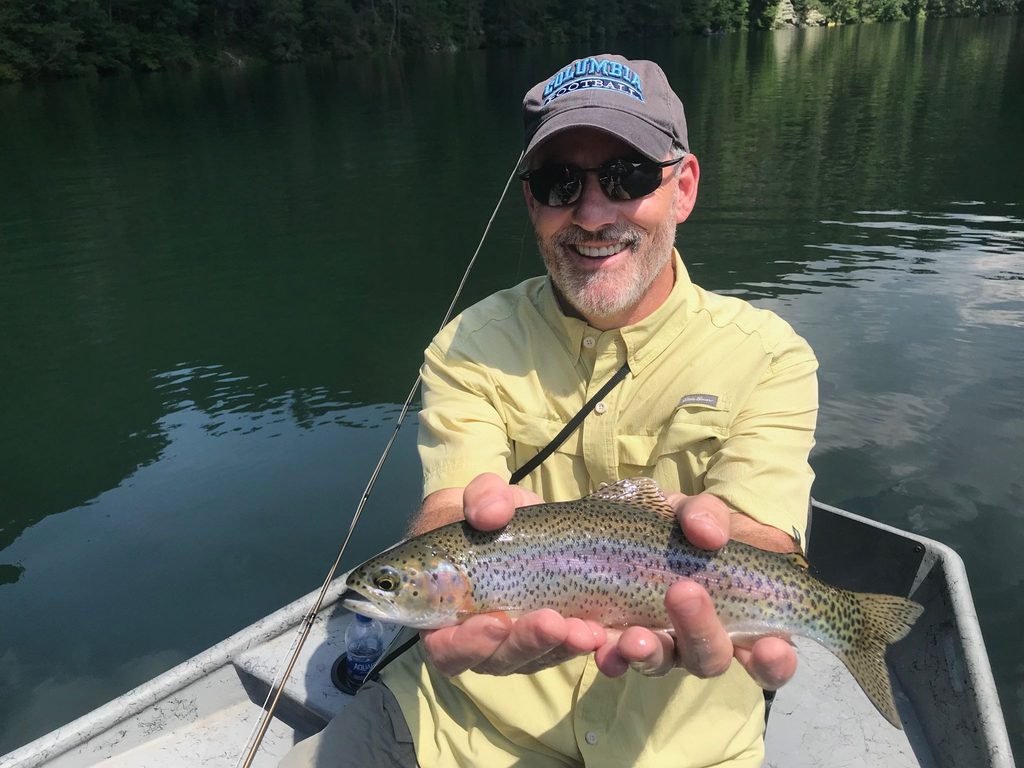
Typically, once I get a fish back into the water that may need extra attention, I will direct its head upstream in as slow water as possible, and then let the fish swim out of my hands to make sure it has recovered. As you get more experienced, you learn when a fish is struggling or not and can let it go much faster.
You are going to make mistakes. All of us get our lines and flies all tangled up through poor casting or by making too strong of a hook set that misses. Untangling lines is an exercise in meditation and patience.
Catching fish may not be that easy at first. You will get discouraged. It took me at least two to three weeks of fishing several hours a week before I caught my first fish. Don’t make the mistake of giving up. You will catch a fish and then the more you fish after that, the easier it will become. Keep looking for answers and try different techniques.
Keep moving as well. Beginners tend to keep fishing in the same place. If you are not having any luck in one section of the river, move to another section. This is especially true in small streams where the fish can get easily spooked. Five casts without catching a fish, move on upstream.
In between fishing expeditions, do your homework. Watch lots of videos. Read lots of books. Learn about the fish and where they like to hang out. Think like a fish. Fish on!
And when you’re ready to plan your next fishing trip, having the right information about the water, fishing conditions and nearby spots can make all the difference.
The Fishbox app can help you discover fishing spots and plan your time on the water. It’s another useful resource to have as you build confidence and get more experience as a fly fisherman.
If you’re just starting out, remember that your first fish might take a little time. Enjoy the process, keep practicing, and most importantly, get out there and fish!
For me, that’s what keeps me coming back—the freedom to explore, the solitude of unexplored waterways, and the never-ending hunt for that next big largemouth bass.
Sam Meisler is a fly fisherman in Central Oregon and East Tennessee, exploring creeks, alpine lakes and rivers, with a passion for helping beginners get into fly fishing.