
Any question about the article?
Please use your work e-mail, so we can connect with you
Muskies (Muskellunge) and Pike (Northern Pike) are easily two of the most sought-after freshwater game fish in North America. Anglers across the United States get their rods out and boats ready day after day in the hopes of landing one of these monster freshwater species for themselves.
Known as the ‘fish of a thousand casts,’ Muskies are no walk in the park to catch, so don’t expect to land a record-breaking fish every time you head out on the water. On the other hand, the ‘water wolves,’ Northern Pike, aren’t much easier to catch when you consider their razor-sharp teeth, size, and power. If you’re looking for an easy fish to catch, it’s not either of these two fish!
In the following article, we’re going to dive right into the world of Muskies vs. Pike, giving you the knowledge you’ll need to get out on the water and potentially catch one of these freshwater monsters for yourself! However, it’s not going to be easy, and you’ll need a lot of patience and perseverance to potentially hold up one of these fish for the ultimate photograph.
In the following article, Muskie vs. Pike, we’ll cover:
If you’re interested in landing a big Northern Pike, be sure to check out How to Catch Northern Pike – A Comprehensive Guide because it covers everything you need to know about landing one of the fantastic fish.
Catching Pike or Muskies can be a real challenge. Still, thanks to the Fishbox App, a premium Fishing Forecasting App, you’ll have access to advanced technology, including the best time to go fishing and when you’re better off relaxing at home.
As with any story, starting at the beginning with some basic common knowledge questions is always the best method. Before jumping headfirst into Muskies vs. Pike, we’ll answer some of the most frequently asked questions new anglers have about these two epic freshwater predators.
Although Muskies and Northern Pike are close relatives, they’re not the same fish. Both fish are from the ‘Esox’ genus, along with other species of Pickerels and Pike, and share some similarities but they are two different species with different areas of habitation and behavior.
Muskellunge has one of the most varied lists of names and spellings out of almost all freshwater fish species in the United States. Muskellunge, Muscallonge, Maskinonge, Muskie, Musky, and even Milliganong. All are widely used and accepted by anglers.
Typically, Muskie and Pike are around the same size. That’s one of the reasons why some anglers have trouble telling the two fish apart from one another. However, on average, Muskies will grow bigger than Northern Pike. Typically, Pike reaches around two feet in length, but Muskies are common up to four feet in length. The International Game Fish Association (IGFA) record for a Northern Pike is just over 55 pounds, 12 pounds short of the IGFA record for a Muskie.
It’s hard to believe, but Tiger Muskies look even more impressive and fearsome than their relatives the regular Muskie. While a lot of people believe Tiger Muskies are a regional variety or subspecies of regular Muskie, they’re, in fact, a hybrid of a male Northern Pike and a female Muskellunge. Although rare in the wild, many bodies of water have stocked Tiger Muskies. If you’re into catching Northern Pike and Muskies, then a Tiger Muskie should definitely be on your bucket list of ‘must catch’ species.
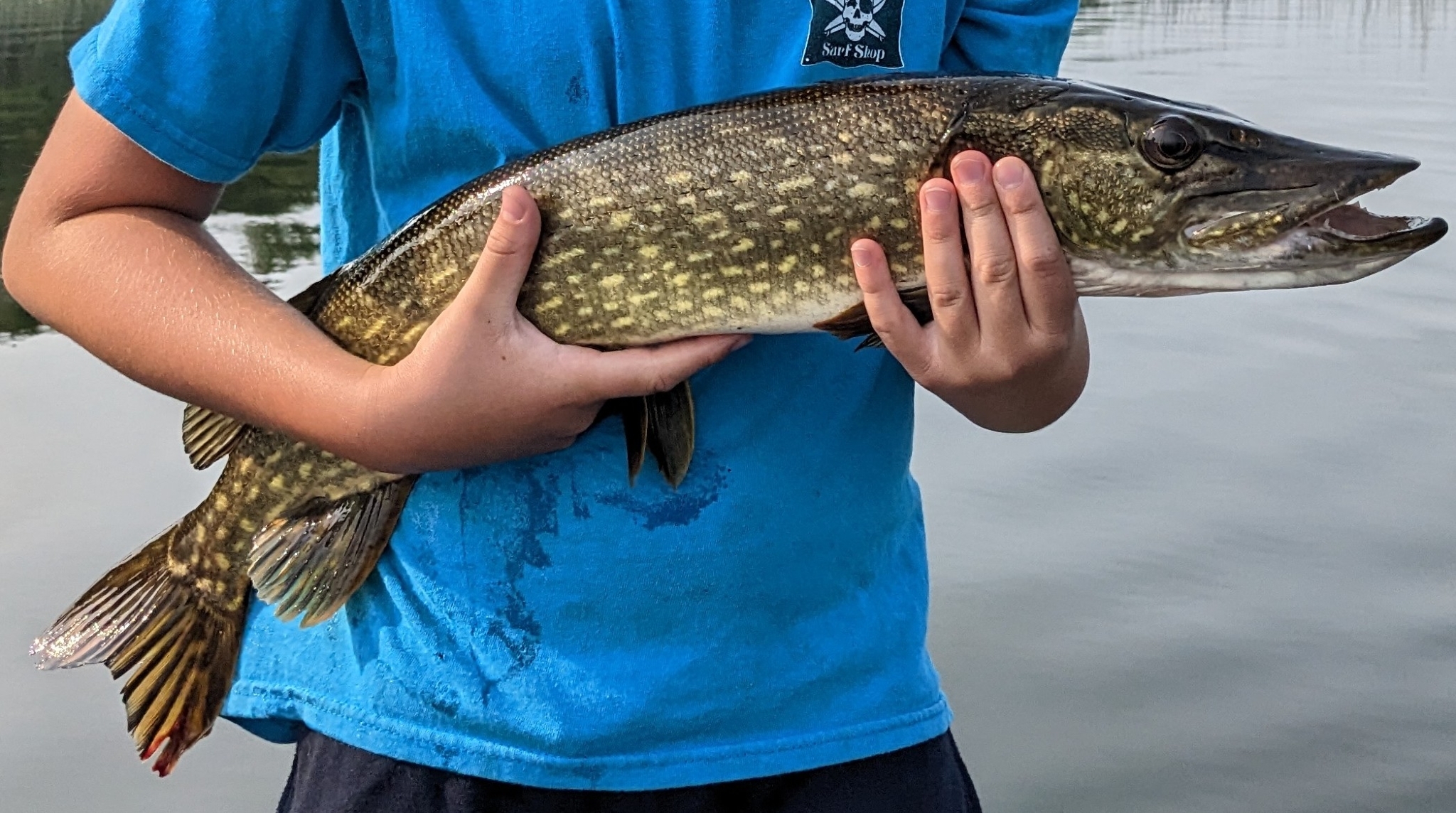
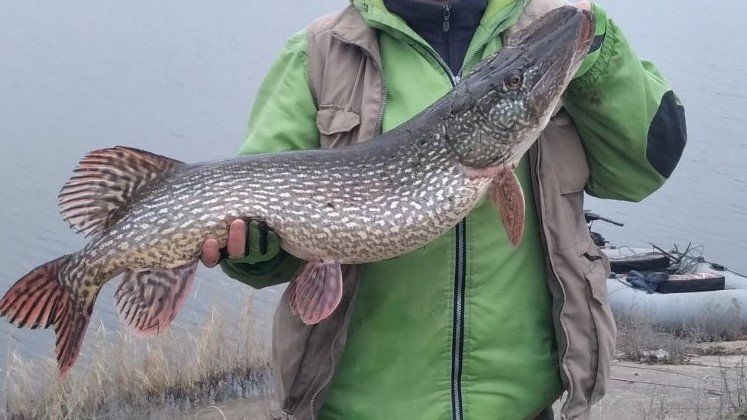
Both Pike and Muskie are long, pointy, and freshwater fish, so how do you easily tell the two species apart from one another? While color is an indicator, it’s not the best, as Muskies have a wide variety of coloring and patterns depending on their environment. However, there are some key indicators that will help you identify the differences between the two fish.
One more less frequently used identification method is the scales. Pike have scales all over their cheeks, but Muskies only have them on the upper half of their cheeks.
Now that you know how to tell the two fish apart, you probably want to know the best place to catch them? Below, we’ll cover the common distribution of Pike and Muskie.
Both species thrive in the waters around the Great Lakes. You’ll find both Pike and Muskie in all of the five lakes and their surrounding rivers.
Pike can commonly be found in most of North America, anywhere from Northwest Alaska over to Eastern Canada. They have also been caught as far south as Arkansas and Oklahoma and in some of the more isolated lakes even further south. They are probably the most widely dispersed of the two species.
On the other hand, Muskies have a more limited area of distribution. As we mentioned above, you’ll find them in the Great Lakes and surrounding rivers and down through the Appalachian Mountains into Georgia. Some Muskies have been caught in Lake Winnipeg and Manitoba, but they’re quite rare.
Although both fish live in different areas of the country, they both spend time in the same habitats within those bodies of water. Both Muskie and Pike are ambush hunters who love to hide in thick cover and vegetation, just waiting for their prey to come to them. Both fish love clear water because they enjoy sight-hunting.
Muskies enjoy large rivers and lakes, but Pike is less worried about where they spend their time, showing up in small rivers and ponds and large lakes or rivers. The best place to start fishing for either of these two species is in weedy sections of rivers or lakes with clear water.
Unless the water temperature is extremely high, you’ll typically find both species hanging around in water up to 40 feet deep. Areas that transition from shallow to deep, with weed banks and vegetation, are always a great place to start fishing.
Large spoons, spinnerbaits, and shallow-running plugs are always effective in tempting a Pike to strike. Live baits are an option, but they need to be sized to the fish you’re targeting to make them tempting enough for a Pike to strike. As winter approaches, Pike will get a little more adventurous in the size of bait or lure as they’re feeding more aggressively as they stock up for the cooler winter months. In spring, when the water is cold, they’ll expend less energy and take advantage of smaller food.
The most crucial tip for Muskie fishing is patience. They’re not known as the ‘fish of a thousand casts’ for no reason. Even a follow when a fish stalks your lure or bait is great, even if they don’t strike it. And if you do manage to hook one, be prepared for an impressive aerial display as they attempt to throw the hook. Same as Pike, fish the weeds and use larger baits as winter approaches. If you don’t want to lose your lure or bait, you’ll need a strong leader, preferably wire.
Hopefully, now you have a clear idea about how to spot the differences between Muskies and Pike, how to catch both species and some of the frequently asked questions new anglers have about Muskies and Pike.
Before you drop a line for either Muskies or Pike, be sure to check with the local fish and game department for season, size, and bag limits in the area you plan on fishing. By following regulations, including purchasing a fishing license or permit, we’re all doing our part to ensure the ongoing health and well-being of the fishery for future generations of anglers.
If you’re new to fishing and looking for help, the premium fish forecasting application Fishbox App will put you in the perfect position by analyzing local weather and water conditions along with input from experienced anglers. The Fishbox App utilizes accurate weather, tide, and fishing conditions to predict the best time to get out on the water to catch your target species.
Do you have some advice or tips for new anglers chasing Northern Pike or Muskies? Drop a comment below. Not only do we enjoy reading your comments and feedback, but your advice could help a new and inexperienced angler land their first big fish.
In my many years of fishing, I unfortunately have never actually gotten the opportunity to fish for either musky or pike. That being said, I was very excited to dive into the article to learn a bit more about these species in order to hone my skills and knowledge when I run across one of them. The article starts with a brief introduction to the two species, citing just how difficult pike, especially musky, can be to catch. This makes it even more important to really get to know these species and what they are like as to better target them in the future.
The article then continues into the next section, where we get some of the frequently asked questions listed. Some of these questions include different species of musky and pike, the general size of the species, and what to expect in the water. For a rookie pike and musky angler such as myself, I found these questions to be extremely insightful.
The next section of the article talks about distinguishing between the two species. The author gives three primary methods to achieve this, such as checking the fish’s tail and markings and counting the pores under the jaw. If you know these three factors well, you should be able to identify which species is which. One other thing I would recommend to help with identification is to study pictures of both species. I myself am a pretty visual learner, so looking at the pictures of which fish is which can be very helpful.
The second to last section in the article describes where you can actually find and catch these awesome fish. The author even breaks this down for us by species. While he doesn’t necessarily give exact bodies of water to fish, he does give us information on where to look, which can honestly be more helpful and freeing as an angler. So, if I were you, and you were going to fish for pike and muskie soon, I would advise reading up on these locations so you can best plan where you should be to maximize your chances of catching one of these fish.
The last section goes into how you can actually catch these fish yourself. Funny enough, pike apparently loves spoons—a bait I love to fish with. Additionally, the article also talks about the aggressive nature of pike when fishing with live bait and the importance of matching the bait size to the size of the fish. For muskie, the article emphasizes patience. These fish are often called “the fish of a thousand casts.” This should give you an idea of what the article is highlighting. Muskie takes a ton of time and patience to catch. I have heard many anglers fishing for days without strikes, but the ones who stick it out and remain patient and confident are the anglers who will ultimately find success.
I had a blast reading this article and learning more about these amazing fish, and I hope you did, too. As always, good luck and tight lines!