

Redbreast Sunfish
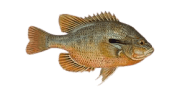
The redbreast sunfish, Lepomis auritus, is a vibrant freshwater species known for its deep orange to reddish belly and striking blue-green body. Commonly found in rivers and streams with moderate flow, this sunfish is a favorite among anglers for its aggressive nature and willingness to bite. It thrives in various freshwater environments, making it a popular target for both recreational fishing and small-scale sportfishing.
 Length~11 (max 30)
 Weight~0.5 (max 1)
 WaterFresh
 Water Temp18-23° F
 Depth2 ft
- Other names-
- Length~11 (max 30)
- Weight~0.5 (max 1)
- WaterFresh
- Water Temp18-23° F
- Depth2 ft
Popular lures for Redbreast Sunfish

Regulation for Redbreast Sunfish
Living Conditions
🐟 Habitat preferences
- Redbreast sunfish prefer clear, flowing waters, typically found in rivers, streams, and sometimes in lakes with a current
- They are often located near submerged logs, rocks, and overhanging vegetation, where they find cover and hunt for food
- Their diet mainly consists of insects, small crustaceans, and occasionally smaller fish, making them versatile feeders
- These fish are often found in areas with sandy or gravelly bottoms, where they can easily forage for prey
♻️ Life cycle and mating behavior
- Redbreast sunfish spawn in late spring to early summer, when males build nests in shallow, sandy or gravelly areas
- The males aggressively guard the nests, attracting females to lay eggs, which are then fertilized
- After spawning, the males continue to protect the eggs until they hatch, ensuring the survival of the young
- Juveniles remain in shallow waters close to the nest site before venturing into deeper waters as they grow and mature