

Mountain Whitefish
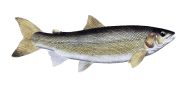
The mountain whitefish (Prosopium williamsoni) is a freshwater fish found across North America, particularly in cold, clear streams and lakes. It is recognized by its slender, cylindrical body and silvery color. A member of the salmon family, this species is prized in recreational fishing for its abundance and the challenge it presents. It feeds primarily on aquatic insects, small fish, and other benthic organisms, making it an important species in freshwater ecosystems.
 Length~25 (max 70)
 Weight~1 (max 3)
 WaterFresh
 Water Temp8-21° F
 Depth10 ft
- Other names-
- Length~25 (max 70)
- Weight~1 (max 3)
- WaterFresh
- Water Temp8-21° F
- Depth10 ft
Popular lures for Mountain Whitefish

Regulation for Mountain Whitefish
Living Conditions
🐟 Habitat preferences
- Mountain whitefish prefer cold, fast-moving streams and clear lakes with rocky or sandy bottoms
- They are often found in deeper pools and riffles, where they search for food near the bottom
- Their diet consists mainly of aquatic insect larvae, small fish, and other benthic invertebrates
- During colder months, they may be found in slower, deeper waters where they are less active
♻️ Life cycle and mating behavior
- Spawning occurs in late fall when temperatures drop, often in shallow, gravelly areas of streams
- Mountain whitefish are known for their group spawning behavior, where many fish gather in one area to release eggs and milt
- After spawning, the adults return to deeper waters, leaving the fertilized eggs to develop unattended
- Juveniles typically remain in shallow waters, feeding on plankton and small invertebrates before moving to deeper habitats as they mature